

Try hiring a mid level staff accountant or tax senior in Chicago, London, Sydney, or Toronto right now. You will wait three months for resumes, compete against giant financial institutions on salary, and still worry that your new hire will leave right before quarter end or busy tax season. Across Western markets, fewer university graduates are entering public accounting each year while veteran CPAs retire in record numbers.
That domestic talent squeeze is the real reason thousands of mid market companies and public accounting practices choose to Outsource accounting to India. What started twenty years ago as simple back office data entry has matured into a strategic global delivery model. Today, when you partner with a specialised offshore accounting services firm or CPA firm outsourcing to India provider, you plug certified Chartered Accountants and US GAAP specialists directly into your cloud ledger. In this guide, we examine the three pillars driving that shift, talent depth, overnight time zone turnaround, and structural cost arbitrage, along with the data security standards every CFO should demand.
Why Global CFOs and CPA Firms Outsource Accounting to India in 2026
Global CFOs and CPA firms outsource accounting to India to solve three critical operational challenges at once: overcoming the domestic accounting talent shortage, accelerating month end and tax turnarounds using an overnight follow the sun schedule, and lowering total finance department overhead by 40% to 60% without compromising audit quality.
Ten years ago, finance leaders looked offshore mainly when they needed to trim budgets. In 2026, capacity and speed sit at the top of the agenda. A growing SaaS, e commerce, or manufacturing CFO cannot wait ninety days to backfill a reconciliation accountant when an investor audit is six weeks away. A managing partner at a regional CPA firm cannot turn away lucrative advisory clients just because their onshore staff are buried in routine bookkeeping and tax workpapers.
India sits at the centre of global finance and accounting outsourcing because no other country combines English speaking business education, rigorous statutory accounting qualifications, and deep familiarity with Western cloud software at comparable scale. Let us break down how each of the three advantages works on the ground.
Pillar 1: Deep Bench of Qualified Accounting Talent and ERP Specialists
India produces hundreds of thousands of commerce graduates, Chartered Accountants, ACCAs, US CPAs, and Enrolled Agents every year. These professionals train directly on US GAAP, IFRS, UK FRS, and Australian tax frameworks while working daily inside QuickBooks, Xero, Zoho Books, Sage Intacct, Odoo, and NetSuite.
The biggest myth about hiring an offshore bookkeeper or accountant is that you will spend months teaching them basic accounting rules. In reality, India's Chartered Accountancy curriculum and international qualification tracks (such as ACCA and US CPA programmes run across Mumbai, Delhi NCR, Bengaluru, Ahmedabad, and Pune) are among the toughest accounting examinations in the world.
Because Indian accounting BPO companies have supported US, UK, Canadian, and Australian businesses for over two decades, the workforce is already organised by jurisdiction and software stack:
- US GAAP and Tax Specialists: Dedicated teams trained in accrual accounting, ASC 606 revenue recognition, multi state sales tax, and federal 1040, 1065, and 1120 workpapers via tax preparation outsourcing.
- UK, European, and Australian Compliance Pods: Accountants experienced in Making Tax Digital VAT filings, Companies House year end statutory accounts, and Australian BAS and superannuation reconciliations.
- Cloud Ledger and ERP Certification: Staff who hold active certifications across outsource quickbooks accounting services, outsource xero accounting services, Zoho Books, Odoo, Sage, BlackLine, and NetSuite.
Pillar 2: The Overnight Time Zone Advantage and 24 Hour Workflows
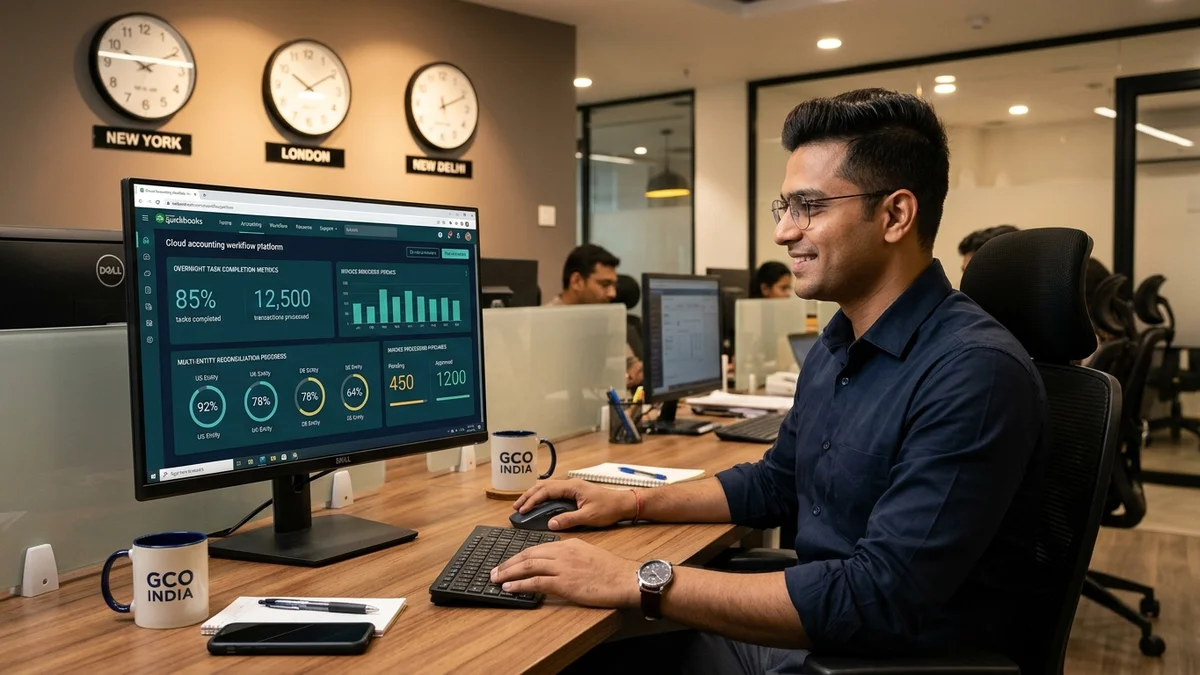
India Standard Time sits 9.5 to 13.5 hours ahead of North America and 4.5 to 5.5 hours ahead of the UK and Europe. This time gap lets global finance teams run a continuous 24 hour workflow where invoices, bank feeds, and reconciliations are completed overnight while onshore managers sleep.
Time zone difference is often treated as a communication hurdle until a CFO sees what an overnight accounting cycle actually does to their month end calendar. Suppose your New York or London office finishes approving vendor bills and issuing customer invoices at 5:30 PM on Tuesday. In a purely local setup, nothing happens to those records until Wednesday morning.
When your offshore accounting team in India logs in during your evening hours, they pick up the queue immediately. By the time your onshore controller opens their laptop at 8:30 AM Wednesday, every Tuesday bank feed is matched, supplier bills are coded via offshore accounts payable outsourcing, and exception queries are waiting neatly in Slack or Teams. We also structure a two to three hour daily overlap window in the morning (for the US) or afternoon (for the UK and Australia) so live video huddles happen in real time.
Pillar 3: Cost Arbitrage That Funds Multi Tier Review Controls
Cost arbitrage in Indian accounting outsourcing lowers total labour and infrastructure spend by 40% to 60% compared to Western metro salaries. Smart CFOs use those savings not just to cut budgets, but to upgrade from a single overworked local bookkeeper to a three tier pod with maker checker review controls.
If you have budget for only one local accounting hire in Boston, Manchester, or Melbourne, that single salary buys you one pair of hands. When that person goes on holiday or falls sick during quarter end, your close stops. Worse, nobody checks their journal entries before the financial statements hit your desk.
For a lower monthly outlay than that single local salary plus payroll taxes, outsourced accounting services in India give you a structured three layer pod: a dedicated staff accountant who prepares daily entries, a reconciliation specialist who handles outsource account reconciliation services, and a senior Chartered Accountant controller who reviews the trial balance and signs off on your outsource financial reporting services pack. You spend less money and get higher internal control quality at the same time.
Which Accounting Functions Should You Outsource to India vs Keep Onshore?
High volume, rule based, and repeatable processes such as daily bookkeeping, accounts payable, accounts receivable, bank reconciliations, payroll calculations, and draft tax workpapers are ideal to outsource to India. Final executive sign off, board relationships, banking negotiations, and physical inventory counts should remain onshore.
The most successful global finance leaders draw a clean line between execution and relationship ownership. The table below shows how corporate CFOs and CPA firm partners split responsibilities between their onshore desk and their Indian delivery pod.
| Finance Function | Best Handled by India Offshore Pod | Best Kept Onshore |
|---|---|---|
| Daily Bookkeeping and Coding | 100% of bank feeds, credit card coding, and journal prep | Approving unusual one off capital expenditures |
| Accounts Payable and Receivable | 3 way PO matching, bill entry, AR invoicing, and collection reminders | Final bank payment release click and key client relationship calls |
| Reconciliations and Month End | Bank, gateway, intercompany, accrual, and balance sheet schedules | Final CFO review of management commentary |
| Financial Planning and Strategy | Building rolling 13 week cash models and variance decks | Presenting packs to the board, investors, and commercial lenders |
| CPA Firm Tax and Audit Work | White label bookkeeping, trial balance clean up, and draft tax returns | Client advisory meetings and final partner tax return sign off |
How to Choose an Engagement Model: Dedicated Staff, Managed BPO, or GCC
Businesses outsourcing accounting to India choose between three operating models: dedicated full time equivalent staff who report directly to your onshore manager, a managed accounting BPO retainer where the provider owns the entire monthly close outcome, or a Global Capability Center in India for large enterprise teams.
Not every company should buy offshore support the same way. Pick the structure that matches your internal management bandwidth:
- Managed Outcome Retainer (Best for Startups and SMEs): If you do not have an internal controller with time to supervise staff daily, choose a managed retainer. The provider owns the close calendar, manages the accountants, and hands you verified financial statements every month.
- Dedicated White Label FTEs (Best for CPA Firms and Mid Market Controllers): If you already have strong standard operating procedures and an onshore manager, hire dedicated full time offshore accountants who work exclusively on your files inside your systems.
- Build Operate Transfer / GCC (Best for Large Enterprises): If you are scaling a captive 25 to 100 person finance, analytics, and technology hub, setting up a global capability center in india gives you your own branded subsidiary with local operational support.
Data Security, Compliance, and Governance Checklist for CFOs
When outsourcing accounting to India, protect sensitive financial data by requiring ISO 27001 and SOC 2 aligned security protocols, zero local file downloads, encrypted VPN or virtual desktop access, role based permissions without bank withdrawal rights, and strict non disclosure agreements backed by physical office controls.
Handing ledger access to an external team across the world naturally raises security questions from your board and IT team. A reputable Indian accounting partner never asks you to email spreadsheets full of bank passwords or social security numbers. Instead, modern offshore delivery uses a zero trust cloud architecture:
- Read Only Bank and View Only Gateway Access: Offshore accountants receive preparer or accountant logins inside QuickBooks, Xero, or NetSuite and read only bank statement feeds. They can set up a bill batch, but only an authorised onshore director holds the token to release funds.
- No Local Downloads or Paper Floors: Staff work inside secure cloud environments with USB ports disabled, screen capture blocked, and biometric entry on delivery floors.
- Audit Trail Transparency: Every single journal entry, reconciliation tick, and document attachment carries a timestamped user log inside your accounting software so external auditors can trace every number in seconds.
How to Onboard an Offshore Accounting Team in India
Onboarding an offshore accounting team in India takes 10 to 14 business days when structured into four clear steps: scoping the chart of accounts and close calendar, granting role based cloud software permissions, documenting standard operating procedures with video walkthroughs, and running a parallel first month close.
Many CFOs delay outsourcing because they worry the transition will consume weeks of their own calendar. In practice, a seasoned Indian accounting partner drives the onboarding process for you using a structured two week playbook:
- Discovery and Ledger Health Check: The onboarding controller reviews your historical trial balance, chart of accounts, prior tax returns, and open bank reconciliations to flag any legacy clean up items before daily processing begins.
- Secure Access and Workflow Mapping: Your IT or finance administrator sets up restricted accountant logins, read only bank feeds, and shared Slack or Teams channels, while our team documents step by step standard operating procedures for bill approvals and payroll processing services.
- Parallel Run and First Close Handshake: The offshore pod processes live daily transactions and reconciles the first week of bank feeds alongside your onshore reviewer, calibrating coding rules so the first month end close runs smoothly on schedule.
Conclusion: Build Your India Accounting Team with Cred Books
The decision to Outsource accounting to India is no longer a secret reserved for Fortune 500 enterprises or Big Four accounting networks. By combining India's deep bench of Chartered Accountants and CPA trained specialists with overnight time zone turnarounds and disciplined cloud security, growing businesses and CPA firms can close books faster, expand advisory margins, and eliminate local hiring bottlenecks for good.
Founded in 2011, Cred Books supports businesses and accounting firms across the US, UK, Australia, Canada, Ireland, the UAE, and India with over 100 certified accounting professionals. Whether you want a managed accounting pod, dedicated white label staff for your CPA practice, or an offshore finance centre, we integrate into your workflow within days. Contact us to build an offshore accounting setup around your goals.
Frequently Asked Questions
Direct answers to the questions global CFOs, founders, and CPA firm partners ask most before outsourcing accounting to India.
Q1 Why do global CFOs and CPA firms outsource accounting to India?
Global CFOs and CPA firms outsource accounting to India to access a deep pool of Chartered Accountants and US CPA trained specialists, use the 9 to 13 hour time zone difference for overnight workpaper turnaround, and reduce finance operating overhead by 40% to 60%.
Q2 Are Indian offshore accountants trained in US GAAP, IFRS, and Australian or UK tax rules?
Yes. Leading offshore accounting firms in India employ Chartered Accountants, ACCAs, and enrolled agents trained specifically in US GAAP, IFRS, UK FRS, and Australian BAS compliance, working directly inside QuickBooks, Xero, NetSuite, Sage, and CCH.
Q3 How does the overnight time zone advantage work in practice?
India is 9.5 to 13.5 hours ahead of the US and 4.5 to 5.5 hours ahead of the UK and Europe. When an onshore team finishes its workday, the Indian accounting pod processes bank feeds, vendor bills, and tax workpapers overnight so reconciliations are ready the next morning.
Q4 How is client financial data kept secure when outsourcing to India?
Enterprise accounting providers in India protect financial data using ISO 27001 and SOC 2 aligned controls, encrypted virtual desktop infrastructure, role based software permissions, multi factor authentication, zero local file downloads, and biometric delivery offices.
Q5 Should a company use an outsourced accounting partner or set up a Global Capability Center in India?
Startups, SMEs, and mid sized CPA firms get faster results with a managed outsourced accounting partner that provides ready pods on day one. Large enterprises building a 25 plus person captive finance and technology hub often establish a Global Capability Center in India.