
Your factory ships product every day, yet the monthly profit figure never matches what the shop floor feels like. Raw material is sitting in three places, a batch is half finished, and nobody agrees on what a finished unit really costs. Standard bookkeeping software was never built for that.
This guide explains the best accounting software for manufacturing business owners in 2026. We'll cover what a manufacturer needs from the ledger, compare QuickBooks, Xero, Zoho Books, Sage, Odoo and NetSuite, and show how to pick by production volume. If you'd rather have specialists look after the numbers, the Cred Books team behind our outsourced accounting for manufacturing companies service works inside all six platforms.
What Does Manufacturing Accounting Software Need to Do?
Manufacturing accounting software must track inventory through three stages, raw materials, work in progress and finished goods. It also needs multi level Bills of Materials, job costing that splits direct material, direct labour and overhead, and variance reporting. Without those, a manufacturer cannot know the true profit on any product.
A trading company buys and sells the same item. A manufacturer buys parts, adds labour and machine time, and sells something different. That conversion is where profit is made or lost, and it has to be recorded step by step. Essential capabilities include:
- Bill of Materials management, so every finished product has an exact recipe of components, quantities and assembly steps.
- Work in progress valuation, so material and labour costs sit in an asset account until production is complete.
- Landed cost tracking, so freight, customs duties and handling are added to the purchase price of raw materials.
If a tool can't do these three, it will force you into spreadsheets. And spreadsheets are where factory margins go to hide.
Best Accounting Software for Manufacturing Business: Top Options Compared
Manufacturers choose between a cloud ledger with inventory and production add ons, or a full manufacturing ERP. QuickBooks, Xero and Zoho Books with Zoho Inventory suit small makers. Sage 50 suits established small plants that want assemblies and job costing, while Sage Intacct, Odoo and NetSuite suit growing plants that need multi entity control or one connected system.
The table below compares the platforms that Cred Books supports every day. Pricing models are shown instead of figures, because plans, modules and user counts change often. Ask each vendor for a current quote based on your headcount.
| Software | Best Suited For | Key Manufacturing Feature | Pricing Model |
|---|---|---|---|
| QuickBooks with an inventory add on | Small batch makers and light assembly | Assemblies and live stock tracking, with add ons for production planning | Tiered monthly plans plus any add on |
| Xero with an inventory add on | Small makers with remote or growing teams | Unlimited users and tracked stock, with connected production apps | Monthly plans with no per user fee, plus the add on |
| Zoho Books with Zoho Inventory | Small manufacturers already using Zoho apps | Composite items, multi warehouse stock and purchase orders | Monthly plans for each app |
| Sage 50 | Established small plants needing assemblies and job costing | Inventory assemblies, job costing and purchase tracking | Annual subscription by edition |
| Sage Intacct | Growing manufacturers with several entities | Dimensional reporting and multi entity consolidation | Quote based subscription |
| Odoo Manufacturing | Mid sized plants wanting a modular ERP | Work orders, Bills of Materials and a built in ledger | Monthly fee per user, all apps included |
| NetSuite | Larger plants and multi site groups | Production, inventory, purchasing and finance in one database | Quote based subscription by modules and users |
None of these is the single best answer. A cloud ledger is quick to learn but leans on add ons for production. An ERP keeps everything in one place but asks more of your team during setup. Choose the one whose weaknesses you can live with.
Smaller makers tend to start with QuickBooks or Xero, because bank feeds, invoicing and reports work well and an inventory app handles the stock. If you want a team to run either one, see our QuickBooks accounting services or our outsource Xero accounting services. Zoho Books fits owners who want purchase orders, composite items and stock in one connected suite, and Sage 50 suits plants that want assemblies and job costing inside a single product.
Cloud Accounting With Add Ons vs an Integrated Manufacturing ERP
Small manufacturers often pair cloud accounting in Xero, QuickBooks or Zoho Books with an inventory or MRP software add on to keep setup manageable. Larger plants benefit from a full ERP like Odoo or NetSuite that removes data syncing between separate tools, at the cost of a heavier implementation and more change for staff.
Think about MRP software and the ledger as two halves of one job. The MRP half plans production, orders materials and tracks stock. The ledger half records the money. When they're separate products, a summary of stock movements must flow into the books, and someone has to check it still balances.
A full ERP closes that gap, because production, stock and accounts share one database. A NetSuite ERP setup or an Odoo rollout also handles several warehouses and plants without a spreadsheet in the middle. The cost is a longer rollout and more change for staff. Our comparison of Odoo vs QuickBooks walks through that trade in detail, and our Odoo accounting services team can show you what a manufacturing setup looks like in practice.
Sage Intacct sits in between. It does not run the shop floor, but its dimensions let you report margin by product line, plant and customer group, which is exactly what a growing manufacturer needs from the finance side.
How Does Job Costing Work in Manufacturing Accounting?
Job costing assigns direct material, direct labour and a share of manufacturing overhead to each production batch, so you know the true cost per unit. Standard costing sets an expected cost and reports variances, while actual costing uses real figures. Good job costing software posts these costs to work in progress automatically.
Direct material is easy. You issue parts against the job and the cost follows. Direct labour needs time capture, either from a shop floor terminal or timesheets. Overhead is the tricky one. You choose a driver, such as labour hours or machine hours, calculate a rate and apply it to every job.
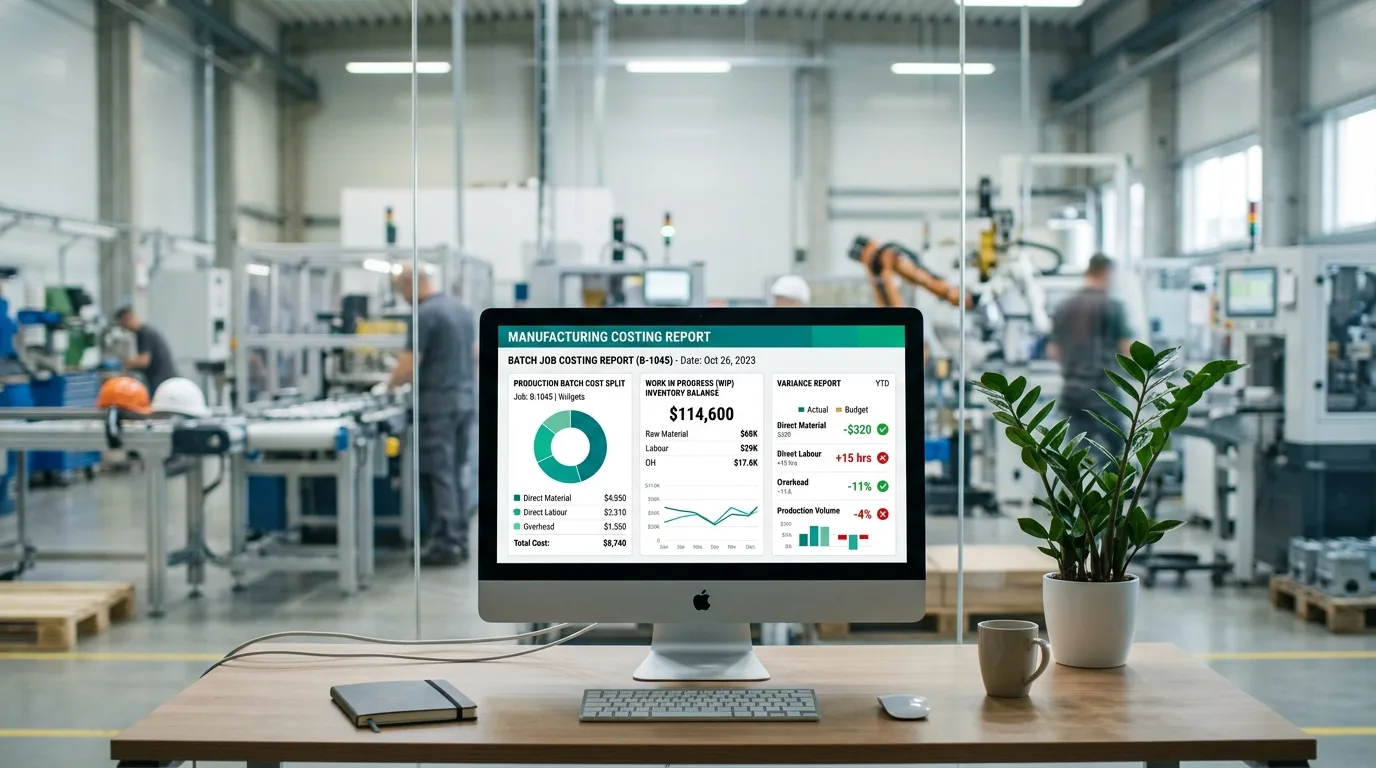
Variances are where the insight lives. A price variance means you paid more for materials than expected. A usage variance means operators consumed more than the Bill of Materials allows. Neither shows up in simple bookkeeping. If you have complex projects or custom orders, our outsource project accounting services team can also set up job level tracking on top of your ledger.
In practice, this is where many owners ask Cred Books for help first. We set up the job or class structure in your software, post material and labour to each batch and review the variance report with you every month, so a small price change does not turn into a margin surprise.
How Should You Value Work in Progress and Landed Costs?
Work in progress inventory is valued by accumulating material, labour and applied overhead from the moment materials are issued until the finished goods are received into stock. Landed cost adds freight, duties and handling to purchased materials. Together they decide your cost of goods sold and, in turn, your reported margin.
Most factories under report landed cost. Freight comes through as an expense, duties land in a different account, and the material cost on the shelf looks cheaper than it really is. Margins then look healthy until a year end stock count says otherwise. Allocate freight and duties to the receipt, and your product costs will finally reflect reality.
Work in progress needs the same discipline. At month end, every open job must carry its material, labour and overhead to date. Inventory is reported at the lower of cost and net realisable value, so slow moving or damaged stock needs a write down. Regular cycle counts and clean reconciliations make these entries small and routine. Our outsource account reconciliation services team handles exactly this kind of ongoing matching.
What Are the Most Common Manufacturing Accounting Mistakes?
The most common manufacturing accounting mistakes are using outdated standard costs, expensing freight instead of capitalising it, skipping regular stock counts, burying scrap inside cost of goods sold, and setting overhead rates by guesswork. Each one distorts product margins and can lead to poor pricing decisions.
Outdated standard costs are the quiet killer. Prices move, yields change and a supplier switch alters the recipe, yet the standard cost sits untouched for two years. Every variance report then shows the same noise, and managers stop reading it.
Scrap is another blind spot. If waste is buried inside cost of goods sold, nobody sees that one machine throws away six percent of its output. Track scrap in its own account and review it monthly. Then fix overhead rates once or twice a year using real data instead of a rough guess, so job costs reflect how the plant really runs. Cred Books accountants flag these issues during the monthly review, usually within the first two closes of a new client.
How Do You Choose Software for Your Production Volume?
Small workshops and light assembly businesses can manage with QuickBooks, Xero or Zoho Books with Zoho Inventory. Plants that need Bills of Materials, assemblies and job costing in one product can look at Sage 50. Growing multi entity plants suit Sage Intacct, while multi stage production with routings suits Odoo or NetSuite.
- Under about ten production orders a week with simple assemblies: QuickBooks, Xero or Zoho Books with Zoho Inventory.
- Regular production with assemblies, purchasing and job costing, but one entity: Sage 50, or a cloud ledger with a stronger inventory add on.
- Multi stage production, routings, work centres, several plants or companies: Odoo Manufacturing, NetSuite or Sage Intacct with a proper implementation partner.
Be honest about staff too. A beautiful MRP system fails if the shop floor won't scan jobs on and off. Choose something your supervisors will actually use, and test it with real batches before you commit.
What Should You Prepare Before Switching Manufacturing Software?
Before switching manufacturing software, clean the item master, verify every Bill of Materials, complete a full physical stock count and design inventory accounts for raw materials, work in progress, finished goods, overhead applied and variances. Pilot one product line first, then roll out to the rest of the plant.
Most failed rollouts trace back to bad data, not bad software. If your Bills of Materials are out of date, the system will faithfully cost the wrong recipe. Spend the first week checking quantities, scrap allowances and supplier part numbers against what the floor actually uses.
Then set up the accounts properly. You want separate inventory accounts for each stage, a clearing account for goods received but not billed, an overhead applied account and clear variance accounts for price, usage and labour. Run one product line through the new system for a full month, compare it against the old figures, and only then migrate everything else. When clients move platforms, Cred Books handles the opening balances and the parallel month end so the old and new inventory values agree on the cutover date.
What Does Month End Close Look Like for a Manufacturer?
A manufacturing month end close includes reconciling bank and supplier accounts, receiving all goods and bills, counting or cycle checking stock, valuing work in progress, applying overhead, reviewing variances and producing profit reports by product line. The aim is a gross margin report you can trust within a few working days.
The close runs in a fixed order. First, make sure every receipt has a matching bill, and every shipment has an invoice. Then, check stock against the physical count and clear differences. Next, value open jobs, apply overhead and review variances. Only then do you publish the profit and loss. Skip a step and the margin report is wrong.
Owners want more than a standard income statement. They want gross margin by product line, scrap rates and cost per unit trends. That reporting layer is what our outsource financial reporting services practice produces from clean ledger data, and it is the report most manufacturing clients say they open first each month.
How Cred Books Keeps Manufacturing Books Accurate
Cred Books provides manufacturers with dedicated offshore certified accountants experienced in inventory valuation, job costing reconciliations and month end closing. The team works inside your current QuickBooks, Xero, Zoho Books, Sage, Odoo or NetSuite file, manages raw material and work in progress adjustments, and prepares gross margin reports for each product line.
Accurate inventory valuation decides whether a factory looks profitable on paper. At Cred Books, every manufacturing client gets a dedicated accountant who learns the product range, the Bills of Materials and the way the plant moves stock. That person works inside your existing system, so nothing about your production process changes.
Here is what the monthly routine usually covers:
- Reconciling raw material receipts against purchase orders and supplier bills, including freight and duty allocation to landed cost.
- Posting work in progress adjustments, finished goods transfers and applied overhead at each month end.
- Reviewing price, usage and labour variances and explaining what moved and why.
- Reconciling bank, supplier and inventory control accounts so the balance sheet matches the stock count.
- Producing gross margin reports by product line, plus scrap and cost per unit trends for the owner.
The same team handles the software side. If you run a cloud ledger such as QuickBooks, Xero or Zoho Books with an inventory add on, we reconcile the add on to the ledger every month. If you run Sage, Odoo or NetSuite, we manage period closes, journal reviews and entity level reporting inside the platform. You keep your tools, and you do not need to hire and train a full time cost accountant.
New clients start with a short review of the item list, the chart of accounts and the last three month ends. We fix what is broken, agree a close calendar and deliver the first margin report within the first reporting cycle. After that, you get the same package on the same date every month, with one person who knows your plant answering your questions.
Conclusion
The best accounting software for manufacturing business owners is the one that matches production complexity, handles Bills of Materials and work in progress properly, and is actually used on the floor. Small makers can pair QuickBooks, Xero or Zoho Books with an inventory add on, established plants can use Sage 50, and growing plants may prefer Sage Intacct, Odoo or NetSuite. Tools help, but accurate inventory valuation still needs careful reconciliation every month. Need expert help organising your manufacturing accounting? Schedule a free consultation with Cred Books and we'll look at your setup.
Frequently Asked Questions
Straightforward answers to the questions factory owners and plant managers ask most about manufacturing accounting software.
Q1 What is the best accounting software for a manufacturing business?
It depends on production complexity. Small batch makers do well with QuickBooks, Xero or Zoho Books paired with an inventory add on. Plants that want assemblies and job costing in one product can look at Sage 50. Growing multi stage plants should consider Sage Intacct, Odoo or NetSuite. Match the tool to your Bills of Materials, job costing and shop floor needs.
Q2 Can QuickBooks handle manufacturing accounting?
QuickBooks handles basic inventory and simple assemblies on its higher plans, which suits light production. It does not manage detailed routings or shop floor control, so many manufacturers add an inventory or production planning app, or move to Odoo or NetSuite once production becomes more complex.
Q3 What is work in progress inventory in manufacturing?
Work in progress inventory is the value of unfinished goods on the production floor. It includes raw materials already issued, direct labour applied and a share of manufacturing overhead. It sits on the balance sheet as an asset until production completes, when the cost moves to finished goods inventory.
Q4 Do I need MRP software or a full ERP for my factory?
MRP software suits small manufacturers who want production planning and stock control alongside an existing ledger. A full ERP suits larger plants that want accounting, production, purchasing and sales in one database. If you run several entities or complex multi stage assemblies, an ERP usually saves effort in the long run.
Q5 How do I calculate landed cost for raw materials?
Landed cost equals the supplier price plus freight, insurance, customs duties and handling charges needed to bring materials to your door. Allocate those extra costs across the items received, usually by value or weight, and record the result as the inventory cost. This gives accurate product costs and margins.