
QuickBooks for Manufacturing Companies
What Is QuickBooks for Manufacturing Companies Accounting?
QuickBooks for manufacturing companies means running your plant books in QuickBooks with a chart of accounts built for materials, labour, overhead and finished goods. Cred Books sets it up and manages it, so every product line gets its own clear cost and margin report each month.
Cred Books delivers specialised outsourced accounting services using QuickBooks for manufacturing companies, supporting small factories, food and beverage producers, fabricators, assemblers and contract manufacturers. Established in 2011, we work with a team of over 100 in house certified accounting professionals. Every client is paired with a dedicated QuickBooks Certified advisor and an experienced QuickBooks certified accountant who understands how manufacturers buy, make and sell.
Manufacturing books tend to break in familiar places. Raw materials, work in progress and finished goods sit in one stock number. Labour and overhead never reach product cost. Scrap and waste are hidden in the cost of sales. Quotes are priced from guesses. It's fixable, and it starts with how QuickBooks is set up. If you want the wider picture, our team can also outsource QuickBooks accounting services for businesses in every other industry.
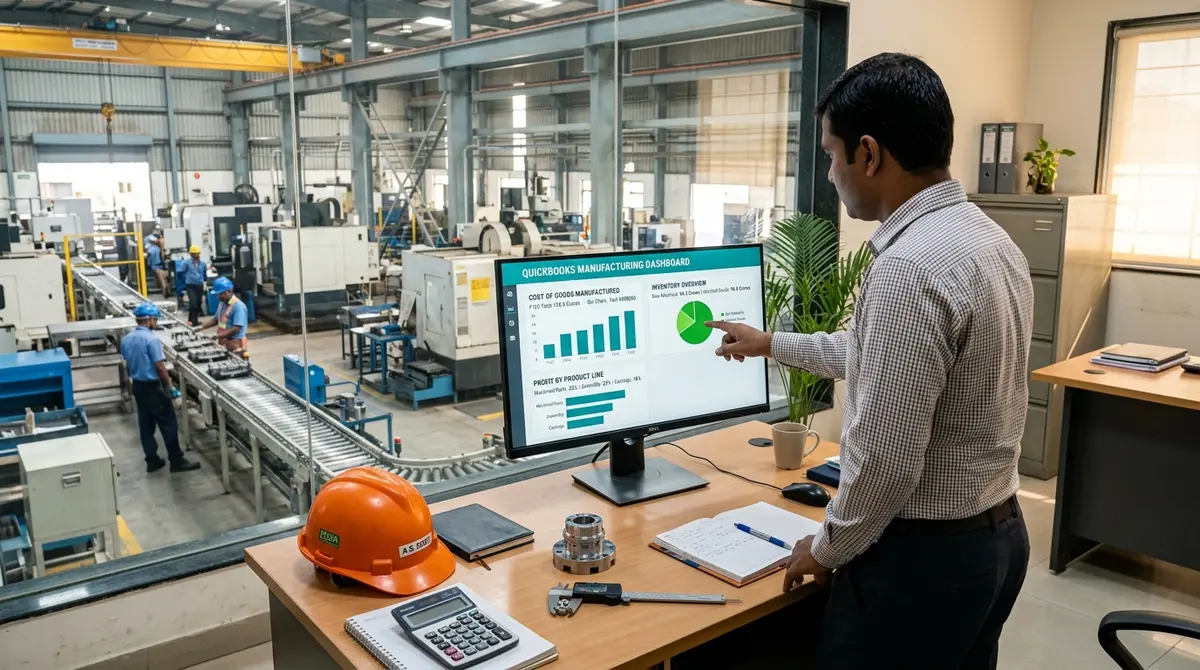
How QuickBooks Handles Materials, Labour and Overhead
QuickBooks can hold raw materials, work in progress and finished goods in separate inventory accounts, with labour and overhead allocated to product cost. Classes split results by product line or plant, so each one shows its own margin.
QuickBooks Online has no full bill of materials or work in progress module, and we don't pretend it does. Larger plants often use QuickBooks Desktop Enterprise for assemblies and advanced inventory, or a dedicated tool such as Katana, MRPeasy or Fishbowl alongside it. For manufacturing inventory accounting, we post summarised journals for material issues, labour and finished goods, then check them against stock counts. Cost of goods manufactured is calculated from reconciled data. Done properly, QuickBooks works well for small and mid sized manufacturers.
What our QuickBooks setup includes:
- Chart of accounts built for materials, labour, overhead, scrap and finished goods
- Classes for product line, plant and customer
- Monthly profit and loss statement for each product line
- Raw materials, work in progress and finished goods tracked apart
- Labour and overhead allocated to product cost
- Scrap, waste and yield tracked each month
- Standard cost against actual cost review
We also link QuickBooks with production and inventory tools such as Katana, MRPeasy and Fishbowl, through a native connection, a connector app or scheduled journal imports, depending on the platform. That keeps material purchases, production costs and sales consistent across every plant. It's the same discipline we bring when you outsourced accounting for manufacturing companies to us.
Our QuickBooks Services for Manufacturing Companies
Everything below runs inside your QuickBooks file. A QuickBooks Certified advisor and a QuickBooks certified accountant handle your plant books every day, from manufacturing bookkeeping to monthly variance reports.
Product Line Profit and Loss
We configure Classes so every income and expense line carries a product line and plant tag. You get a profit and loss for each line and for the whole company from one file, without rebuilding reports every month.
Bank and Supplier Reconciliation
Supplier statements, freight bills and customer receipts are matched to the ledger each month. Duplicate invoices and missing credits are flagged early, so payables stay accurate. This work sits within our Outsource Account Reconciliation Services for Manufacturing Businesses.
Bill of Materials Accounting
Bill of materials accounting links each finished item to the materials and labour behind it. Where QuickBooks has no native module, we use summarised journals or a connected tool.
Cost of Goods Manufactured
Cost of goods manufactured is calculated from materials used, direct labour and overhead. You see the true cost per unit and per batch, not just what was paid to suppliers.
Tax Ready Workpapers
QuickBooks doesn't file returns, so we prepare the support your tax preparer needs, with income, stock values, equipment depreciation and credits grouped by entity. Need a full return? We offer Manufacturing Tax Return Filing Services too.
Variance Analysis
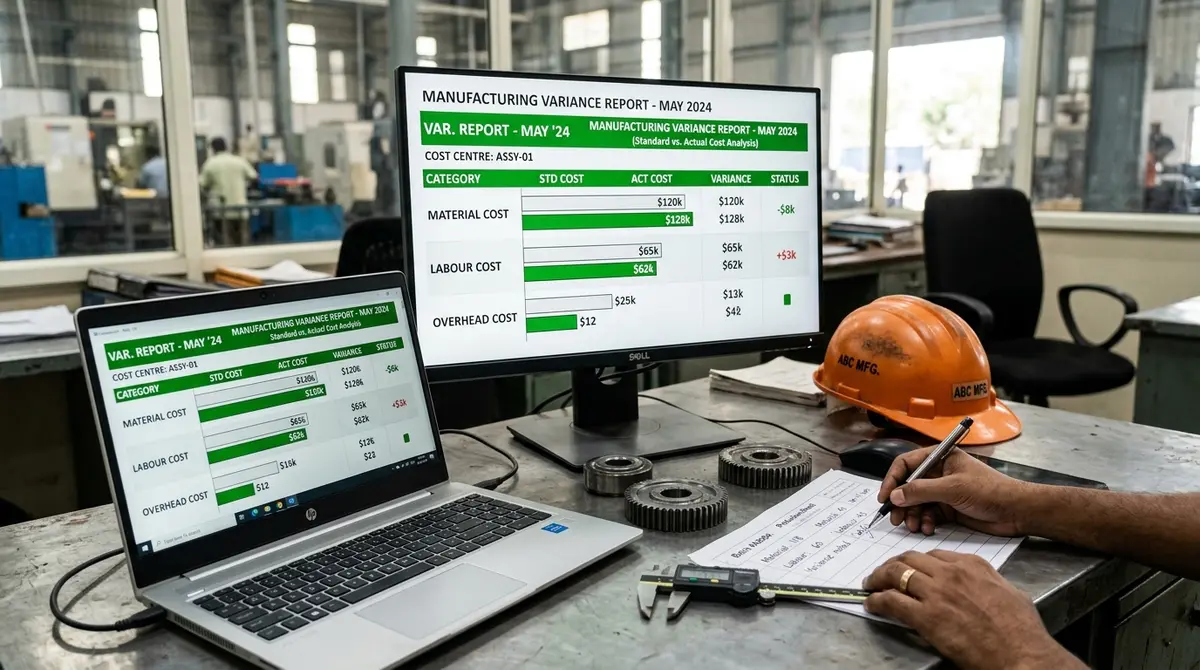
Variance analysis in manufacturing compares standard and actual cost for price, usage and yield. Management sees where margin leaks before it shows up in the bank.
Production Software Integration
Need a Katana QuickBooks integration or a link to MRPeasy or Fishbowl? We connect these platforms through a native connection, a connector app or scheduled imports. Production and stock summaries reach QuickBooks without re keying.
Monthly Manufacturing Reporting
Owners and plant managers receive clear monthly numbers: profit by product line, gross margin, stock value, cash position and budget against actual. We also prepare management packs through our Manufacturing Financial Reporting Services.
Payroll for Production and Office Staff
Machine operators, supervisors and office teams are paid correctly and on time, with labour cost posted to the right product line. Our Manufacturing Payroll Processing Services cover pay runs, filings and cost allocation.
Software Expertise
Cred Books vs In House QuickBooks Accounting: Which Suits Your Plant?
Outsourcing suits manufacturers who have outgrown spreadsheets but don't need a full finance team. Many clients with owners overseas also choose our Offshore Manufacturing Accounting Services to cover several time zones.
| Factor | In house team | Cred Books (QuickBooks for Manufacturing Companies) |
|---|---|---|
| Cost | Salary, benefits, software and training | Accounting costs reduced by 40% to 60% |
| QuickBooks expertise | Depends on one or two staff members | QuickBooks Certified advisor and QuickBooks certified accountant on every account |
| Manufacturing knowledge | Learned on the job | Product costing, stock and variances handled as routine work |
| Reporting | Often late and built by hand | Monthly profit by product line on a fixed schedule |
| Scaling | New hire for every new line | Add product lines and plants without hiring |
| Coverage | Business hours, with gaps during leave | Dedicated team with trained backup |
| Audit readiness | Depends on the individual | Audit ready books with documented workpapers |
Why Manufacturing Companies Choose Cred Books for QuickBooks
Trusted by more than 1,000 clients globally, Cred Books delivers audit ready books and monthly product reports. Here is what that looks like for a manufacturing company.
QuickBooks Certified Advisors
Every client gets a dedicated QuickBooks Certified advisor who configures and reviews the file, plus an experienced QuickBooks certified accountant for the daily work.
Manufacturing Specialists
Our accountants understand how plants buy, make and sell, from material costing to variances, so you don't pay for a learning curve.
Over 15 Years of Experience
Cred Books has been operating since 2011 and has refined its manufacturing company accounting checklists on real files across several countries.
In House Team of 100+
More than 100 in house certified accounting professionals means cover for leave, peak periods and growth. No freelancers and no handoffs to strangers.
Audit Ready Books
Reconciled accounts, documented workpapers and verified stock values give auditors, lenders and owners exactly what they ask for.
Lower Accounting Costs
Clients cut accounting costs by 40% to 60% without lowering quality, because they pay for expertise instead of desks and recruitment.
Which Manufacturing Companies Benefit Most from QuickBooks?
These manufacturers see the biggest gains from plant accounting built on QuickBooks.
Small Factories
Small plants get QuickBooks for manufacturing with stock control, product costing and clear monthly profit.
Food and Beverage Producers
Producers get batch costing, shelf life write offs and yield tracking in one file.
Fabricators and Assemblers
Job shops get material and labour costs matched to each order, with clean quotes based on real data.
Contract Manufacturers
Contract makers get customer level margin, tooling costs and pass through charges recorded cleanly.
Multi Plant Groups
Groups with several plants get one chart of accounts, consistent reports and manufacturing accounting that scales, plus a tidy year end close. See our Year End Accounting Services For Manufacturing Businesses for closing the books cleanly.
Growing Manufacturers
Companies adding a line or a plant get a scalable QuickBooks structure from day one, so growth doesn't mean a messy ledger.
Our QuickBooks Setup Process for Manufacturing Companies
Five steps take you from a messy ledger to monthly product reports. Every step has an assigned accountant and a senior reviewer.
Plant Review
We list your product lines, plants, stock locations and production tools, and note where the books currently break down.
QuickBooks Setup
Our QuickBooks Certified advisor builds the chart of accounts, inventory accounts and Class structure for product reporting.
Software Integration
We connect Katana, MRPeasy, Fishbowl or your current tools to QuickBooks by native connection, connector app or scheduled imports.
Monthly Close
Materials, labour, overhead, stock and supplier bills are reconciled, and a senior accountant reviews the file.
Reports and Tax Workpapers
You receive product level profit reports, variance summaries and tax ready workpapers on a fixed schedule.
Related Services for Manufacturing Companies
Frequently Asked Questions
What is QuickBooks for manufacturing company accounting?
It means using QuickBooks as the accounting system for a manufacturer, with a chart of accounts, Classes and reconciliations built around materials, labour, overhead and finished goods. Cred Books configures and manages it, so plants get product level reports without doing the bookkeeping themselves.
Is QuickBooks good for manufacturing accounting?
Yes for small and mid sized plants, when it is set up properly. QuickBooks offers bank feeds, bills, inventory tracking, Classes and strong reporting. It has no full bill of materials or work in progress module in the online version, so a connected tool or Desktop Enterprise may be needed.
How do you calculate cost of goods manufactured?
Add direct materials used, direct labour and manufacturing overhead, then adjust for the change in work in progress stock. The result is the cost of goods completed in the period. Cred Books calculates it monthly from reconciled data, so unit costs and margins are reliable.
How do you handle bill of materials in QuickBooks?
QuickBooks Online Advanced offers limited bundles, while QuickBooks Desktop Enterprise has assemblies and advanced inventory. For complex products, a tool such as Katana, MRPeasy or Fishbowl holds the bill of materials and sends cost summaries to QuickBooks. We choose the right route for your plant.
Does QuickBooks work with Katana, MRPeasy or Fishbowl?
In most cases, yes. Depending on the platform, the link is a native connection, a connector app or a scheduled journal import. Either way, production and stock summaries reach QuickBooks without re keying. Our team checks the account mapping before go live and reviews the sync every month.
What is variance analysis in manufacturing?
It compares standard cost with actual cost and explains the gap, usually by price, usage and yield. A purchase price variance shows supplier changes, while a usage variance shows waste. The Institute of Management Accountants publishes useful guidance on cost management.
What is a QuickBooks Certified advisor?
A QuickBooks Certified advisor is an accountant or bookkeeper who has passed Intuit's QuickBooks Online certification through the ProAdvisor program and knows how to set up and manage the platform. At Cred Books, every manufacturing company client gets a dedicated QuickBooks Certified advisor, plus an experienced QuickBooks certified accountant who handles the daily work.
How much can outsourcing QuickBooks accounting save a manufacturing company?
Cred Books clients typically reduce accounting costs by 40% to 60% compared with running the same work in house. The saving comes from skipping salaries, benefits, software training and recruitment, while still getting certified accountants and a monthly review of every file.
How long does it take to move a manufacturing company to QuickBooks?
Most QuickBooks migrations handled by Cred Books take between 3 and 7 business days. The timeline depends on how much history you bring across, the number of locations or entities, and how clean your existing records are.
Is QuickBooks or Xero better for a manufacturing company?
Both work. QuickBooks suits manufacturers that want inventory tracking, Desktop Enterprise options and the widest choice of production tool connections, and it is common in the United States. Xero suits smaller makers that want simple bank feeds and light inventory add ons. We set up either one, and recommend based on plant size, country and costing needs.
Why choose Cred Books for QuickBooks for Manufacturing Companies?
Cred Books has run outsourced accounting since 2011, with more than 100 in house certified accountants and over 1,000 clients worldwide. You get a named QuickBooks Certified advisor, a QuickBooks certified accountant, a monthly senior review and manufacturing company specific checklists rather than a generic bookkeeping service.