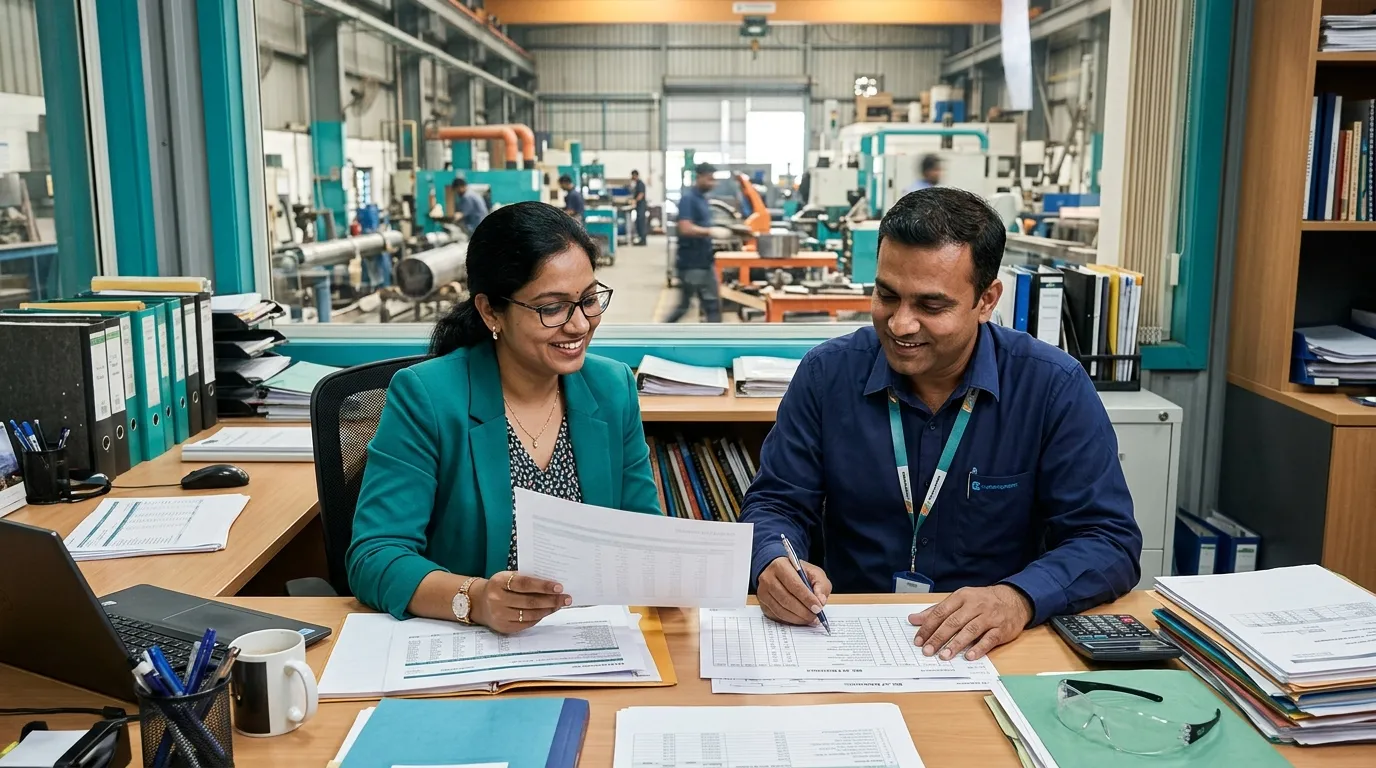
Manufacturing financial reporting services cover the complex accounting requirements of factories and production lines. Unlike service businesses, manufacturers must account for the physical transformation of raw materials into finished goods. This requires precise inventory valuation, tracking of Work In Progress (WIP), and complex overhead absorption models to determine the true cost of production. Rather than building an expensive in-house finance team to manage these complexities, manufacturing firms engage Cred Books to deliver accurate, audit-ready reporting on a fixed monthly cycle.
Cred Books has delivered reporting for precision engineering firms, food and beverage manufacturers, and consumer goods producers across the UK, Europe, and the US. Every client receives tailored management accounts that highlight production variance, allowing plant managers and directors to understand exactly where margins are being lost on the factory floor.

Standard accounting treats all expenses as immediate costs. In manufacturing, the cost of raw materials, direct factory labor, and manufacturing overheads must be capitalised into the value of inventory. These costs only hit the P&L as Cost of Goods Sold (COGS) when the item is finally sold. Getting this inventory valuation wrong misstates both the balance sheet and the monthly profit margin. Many manufacturers suffer from "rollercoaster margins" simply because their WIP accounting is inaccurate.
Furthermore, manufacturers need to analyze standard costing vs actual costing. If a product was estimated to take 2 hours of labor but actually took 3, the finance system must flag this production variance immediately. A standard outsourced accounting services provider will fail to navigate this level of operational detail. Cred Books specialises in it, bringing factory-floor realities into the cloud accounting ledger.
We implement robust month-end procedures to accurately value raw materials, Work In Progress (WIP), and finished goods, ensuring your balance sheet reflects the true value of your stock.
We analyze the difference between your standard costing and actual costing. We break down variances into material price, material usage, labor rate, and labor efficiency to pinpoint exactly where margins are leaking.
We design models to accurately allocate indirect manufacturing costs (factory rent, utilities, depreciation) to your finished products, ensuring your pricing strategy covers all operational realities.
We regularly audit and reconcile your BOMs within your ERP against actual ledger costs, ensuring that your theoretical product margins align with your actual financial performance.
We manage the accounting for heavy machinery investments, tracking CapEx projects from approval to commissioning, maintaining the fixed asset register, and calculating accurate depreciation.
We strictly segregate direct production labor (which is capitalised into inventory) from indirect supervisory labor, ensuring your gross margin calculations remain precise and compliant with accounting standards.
For manufacturers sourcing raw materials globally, we manage multi-currency ledgers, tracking realized and unrealized foreign exchange gains or losses to protect your purchasing power.
We manage complex supplier payment terms, trade finance facilities, and letter of credit accounting, optimizing your working capital cycle between paying suppliers and collecting from customers.
Preparation of the annual financial statements in full compliance with local GAAP or IFRS, providing your external auditors with fully reconciled inventory and WIP schedules.
If a business buys materials in January but doesn't finish manufacturing the product until March, those costs cannot be expensed in January. They must be held on the balance sheet as WIP. Many manufacturers fail to track this monthly, resulting in wild, inaccurate swings in their reported profitability.
If factory rent is £10,000 a month, how much of that rent should be added to the cost of "Product A" versus "Product B"? Without a precise overhead absorption model, manufacturers often under-price complex products and over-price simple ones, unknowingly damaging their market competitiveness.
ERP systems rely on "Standard Costs" (the theoretical cost to make an item). However, material prices fluctuate, and labor efficiency varies. Financial reporting must calculate and investigate these variances to ensure the business isn't losing money due to shop-floor inefficiencies.
Manufacturing inevitably produces scrap or offcuts. If this scrap has salvage value, or if the yield of a raw material is lower than expected, the accounting system must capture this. Ignoring scrap costs artificially inflates the perceived gross margin of the product line.
| Reporting Area | In-House Finance Team | Cred Books |
|---|---|---|
| Month-End WIP Valuation | Often guessed or only calculated at year-end | Calculated and journaled accurately every month |
| Variance Analysis | Generalised reasons for margin drops | Specific breakdown of material vs labor variances |
| Overhead Absorption | Simple, often inaccurate flat-rate spread | Data-driven allocation based on machine/labor hours |
| ERP Integration | Manual entry between production system and ledger | Automated mapping between ERP and accounting software |
| Audit Readiness | Stressful scramble to prove stock valuations to auditors | Fully reconciled inventory schedules ready on day one |
| Cost Efficiency | High fixed salaries for experienced cost accountants | Fixed monthly fee for an entire specialist finance team |
For most manufacturers, inventory is the largest asset on the balance sheet. If obsolete stock is not written down, or if WIP is overvalued, the company's net worth is artificially inflated, which can severely impact bank covenants and financing.
If a factory produces 10,000 units but only sells 2,000, the costs of the 8,000 unsold units are capitalised into inventory. This makes the P&L look highly profitable because expenses are deferred. We provide cash flow reporting to ensure you don't mistake inventory build-up for actual cash profit.
If a factory operates at 50% capacity, the fixed overheads per unit double. Standard accounting must decide whether to charge this "idle capacity variance" directly to the P&L or add it to inventory value (which is generally restricted by accounting standards).
A Bill of Materials (BOM) is a recipe. If the engineering team changes a component, or the procurement team sources a cheaper alternative, the BOM must be updated in the finance system immediately. Disconnects here cause massive margin discrepancies at month-end.
We review your current ERP/inventory system, map your manufacturing workflow, and assess how BOMs, labor hours, and material consumption are currently tracked on the shop floor.
We design a robust standard costing and overhead absorption model. We establish the correct treatment for direct vs indirect labor, scrap, and WIP valuation to ensure compliance with accounting standards.
At month end, we process manufacturing journals, perform balance sheet reconciliations on inventory accounts, and issue a management pack detailing specific production variances by the 10th.
We meet with your plant managers to discuss margin improvements. At year end, we prepare the statutory financial statements, providing auditors with a clean, fully documented inventory valuation.
We speak the language of BOMs, routing steps, standard costing, and WIP. You won't need to teach us how a factory works; we already understand the operational realities.
By implementing strict month-end WIP and inventory journals, we smooth out the artificial margin spikes and dips caused by poor cash-basis accounting, giving you a true picture of profitability.
We don't just tell you that profits are down. We tell you exactly which product line suffered a negative material price variance or a labor efficiency variance, allowing you to fix the root cause.
We integrate core ledgers like QuickBooks and Xero with modern manufacturing systems (DEAR, Unleashed, Katana), bridging the gap between operations and finance.
We provide enterprise-grade manufacturing reporting for a predictable fixed monthly fee, offering significantly better value than hiring a full-time internal Cost Accountant. We also offer broader financial reporting services for diverse business groups.
These services provide specialist accounting for production environments, focusing on precise inventory valuation, tracking work-in-progress (WIP), overhead absorption, and providing detailed production variance analysis.
We implement strict month-end processes to value raw materials, Work In Progress (WIP), and finished goods. This capitalises production costs on the balance sheet until the goods are sold, preventing artificial margin fluctuations.
It's the process of comparing your "Standard Costs" (what a product should cost) against the "Actual Costs" incurred. We break this down into material price, material usage, and labor efficiency variances to identify margin leaks.
We design data-driven models that allocate indirect factory costs (like rent, utilities, and supervisor salaries) into the cost of your finished products based on machine hours or labor hours, revealing true net profitability.
Yes. We manage the accounting for heavy machinery investments, tracking CapEx projects from approval to commissioning, maintaining the fixed asset register, and calculating accurate statutory depreciation.
If you purchase raw materials in foreign currencies, we manage multi-currency consolidation within the ledger, actively tracking realized and unrealized foreign exchange gains and losses.
We integrate core ledgers like Xero and QuickBooks with specialist manufacturing ERPs and inventory management systems (such as DEAR, Unleashed, or Katana) to automate the flow of production data into finance.
Ready to Fix Your Manufacturing Financial Reporting?
Talk to a manufacturing finance specialist. Fixed monthly fee. WIP and BOM experts. No lock-in contracts.
Get a Free Consultation